
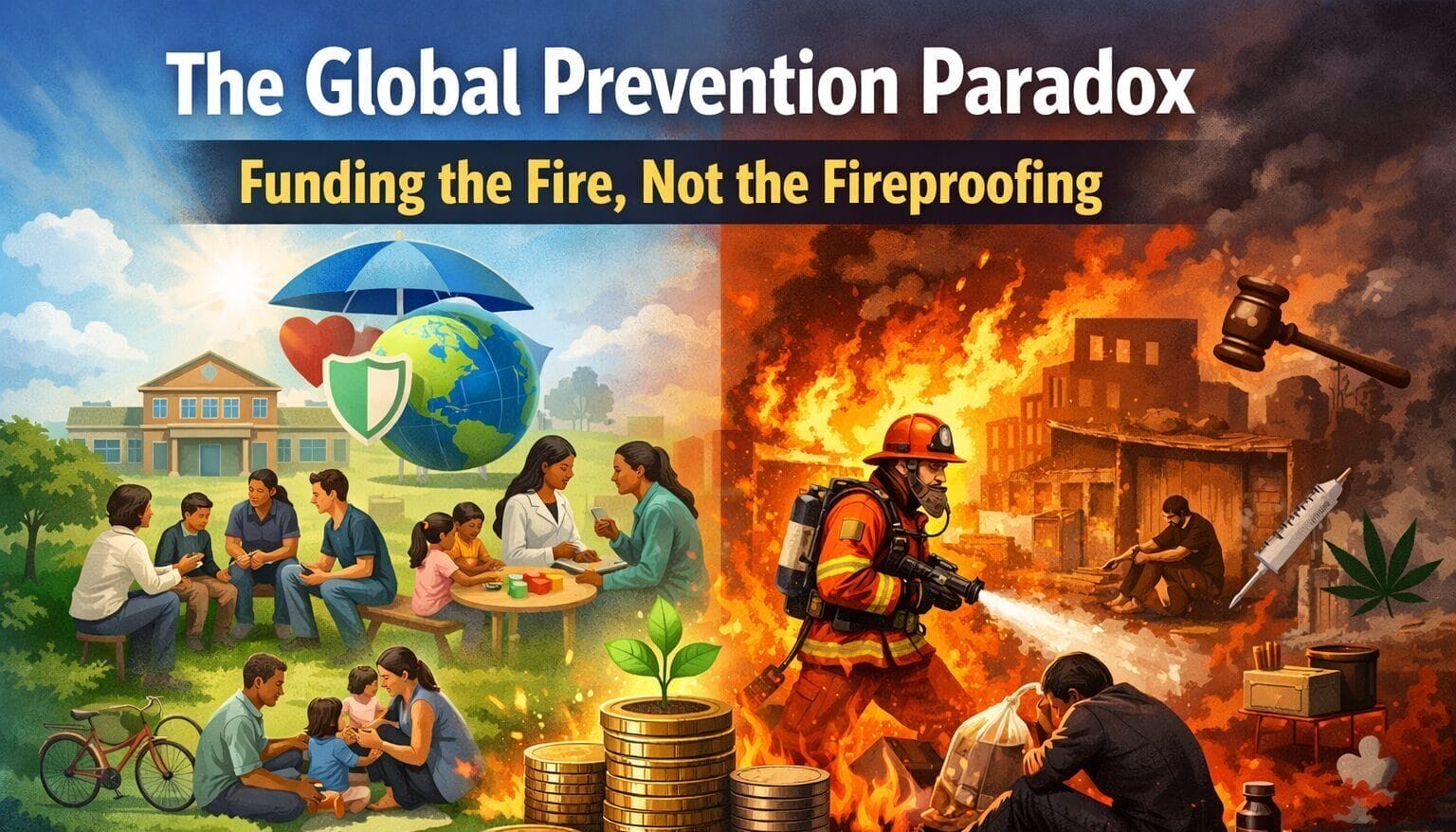
In global public health and social policy, a striking paradox persists—one that quietly undermines sustainability, equity, and long-term impact.
Around the world, philanthropic foundations, bilateral donors, private funders, and also governments overwhelmingly invest in downstream responses: treatment of disease, addiction services, harm reduction, emergency relief, and advocacy around crisis mitigation. These investments are often well-intentioned, evidence-informed, and urgently needed.
Yet systematic, high-quality prevention—the very approach that could reduce the future need for these costly interventions—remains chronically underfunded, fragmented, and politically sidelined.
This is not merely a funding gap. It is a strategic failure.
Treating the Symptoms While Ignoring the System
Whether we look at non-communicable diseases, mental health, substance use, or social inequalities, the pattern is consistent:
- Funding flows to treatment and recovery.
- Strong support exists for harm reduction and crisis services.
- Increasing resources are directed toward policy reform and legalization debates.
- Prevention—especially long-term, evidence-based, population-level prevention—receives a fraction of the attention.
The result? We continuously finance the consequences of systemic failures while investing very little in stopping those failures from emerging in the first place.
This logic would be unthinkable in other sectors.
We would not build hospitals without investing in clean water.
We would not finance fire brigades without fire codes.
We would not fund prisons without investing in education.
And yet, in public health and substance use policy, this is precisely what we do.
The Cost of Neglecting Prevention
Robust prevention is not about slogans or awareness campaigns. It is about:
- Early childhood development
- Family-based and school-based interventions
- Community-level protective environments
- Policy coherence across alcohol, tobacco, illicit drugs, nutrition, and mental health
- Addressing risk and protective factors long before problems manifest
Decades of research—including WHO, UNODC, and EU standards—demonstrate that evidence-based prevention is one of the highest return-on-investment strategies in public health.
And yet, prevention is often seen as:
- Too slow
- Too complex
- Too political
- Too difficult to attribute outcomes to a single donor
Ironically, these are precisely the reasons it matters most.
Philanthropy’s Blind Spot
Many of the world’s most influential philanthropic actors have shaped global health agendas in powerful ways. Organizations such as Bill & Melinda Gates Foundation, Open Society Foundations, and Bloomberg Philanthropies have made historic contributions to disease control, health systems strengthening, tobacco regulation, harm reduction, and policy reform.
However, when it comes to comprehensive, long-term prevention systems, funding remains:
- Project-based rather than systemic
- Fragmented rather than strategic
- National or local, but rarely globally coordinated
- Reactive instead of anticipatory
Even where prevention is mentioned, it is often reduced to communication campaigns rather than sustained structural investment.
Prevention Is Not the Opposite of Harm Reduction or Treatment
This is not an argument against treatment, recovery, or harm reduction. These services save lives and must be protected.
But without strong prevention, they will never be sufficient.
A system that continuously expands treatment capacity without reducing incidence is not a success—it is a warning sign.
True balance requires:
- Prevention to reduce future demand
- Early intervention to catch problems sooner
- Treatment and recovery for those already affected
- Policies aligned with health, not ideology or commercial interests
The Missed Opportunity: Global Prevention Advocacy
Perhaps the most overlooked gap is the absence of strong, well-funded global prevention advocacy platforms.
While other fields benefit from:
- Global networks
- Professionalized advocacy
- Clear narratives and measurable goals
Prevention advocates are often:
- Under-resourced
- Marginalized in policy debates
- Expected to »compete« with industries and well-funded policy movements
Without coordinated advocacy, prevention remains the quiet cousin in global health—respected in theory, ignored in practice.
A Call for Strategic Courage
If philanthropic funders (and governments) are serious about sustainability, equity, and long-term impact, prevention must move from the margins to the centre.
That means:
- Investing in systems, not just projects
- Funding global prevention platforms and networks
- Supporting capacity building, standards, and evaluation
- Resisting short-term political trends in favour of long-term population health
The real question is not whether we can afford prevention.
The question is: How long can we afford to ignore it?
Prevention does not make headlines.
It makes crises disappear.
And that may be the most transformative impact philanthropy can achieve.
Written by: Matej Košir, UTRIP (Slovenia) (matej@institut-utrip.si)